
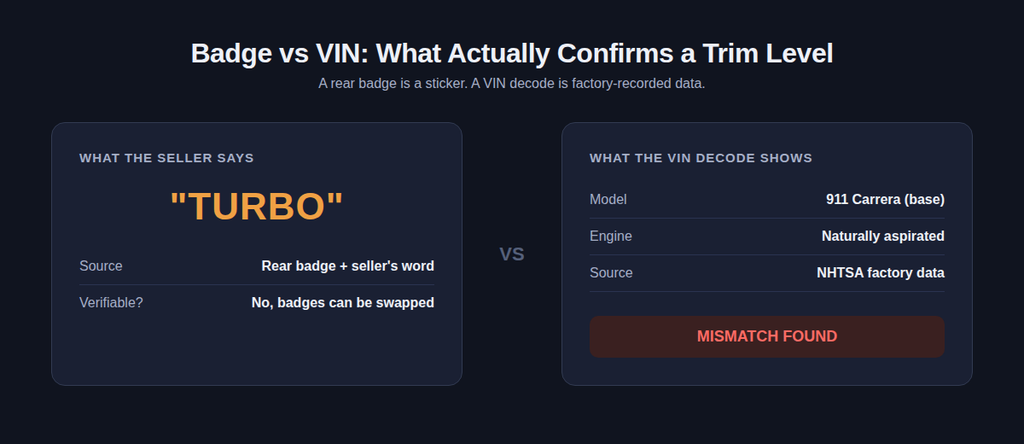
I met a guy at a small car meet a couple summers ago who was showing off what he called his “Turbo.” Badge on the back said Turbo. He said Turbo. Half the crowd around him nodded along and admired it. I didn’t say anything at the time because it wasn’t my business to ruin someone’s evening, but I went home and looked up the VIN he’d posted earlier in a group chat when he was still trying to sell it. It wasn’t a Turbo. It was a base Carrera with a badge somebody had swapped on at some point, probably to help it sell for more. That’s the moment I actually understood why a Porsche VIN decoder is not a nice-to-have for this brand specifically. It’s necessary.
Why This Matters More for Porsche Than Most Brands
Porsche’s own model lineup is built almost entirely around small differences that carry huge price implications. A Carrera and a Carrera S can look nearly identical from ten feet away. A base 911 and a Turbo share the same body shell. Badges are stick-on plastic and metal trim pieces, and in the used market, badge swapping happens often enough that Porsche enthusiast forums have entire threads dedicated to spotting it. Nobody is regulating what badge sits on the back of a car once it leaves the factory. The VIN, on the other hand, is factory-recorded data that nobody swaps out. That’s the actual difference between trusting a badge and trusting a VIN.
Where the Real Information Lives
Every Porsche sold in the US carries a standard 17 character VIN, same as every other manufacturer since 1981. The first three characters are the World Manufacturer Identifier. Most US market Porsches start with WP0 or WP1, both assigned to Porsche AG in Germany. Positions 4 through 8 hold the actual descriptive data: model line, body style, engine, and restraint system, encoded in a format that only Porsche’s internal reference tables translate into plain words. Position 9 is a check digit, a single character calculated from the rest of the VIN, whose only job is catching typos or an outright fake number. Position 10 encodes model year on the same repeating cycle every manufacturer uses. Position 11 identifies the assembly plant, usually Zuffenhausen for the 911 specifically. The last six digits are simply the production sequence number for that car. A decoder’s whole job is turning positions 4 through 11 into words a normal person can read, instead of leaving you to guess at what a run of letters and numbers means.

A Worked Example
Take a VIN structured like WP0AB2A99FS100001. WP0 confirms it’s a Porsche built in Germany, which is at least a fast way to catch a VIN that clearly isn’t what someone claims. Positions 4 through 8, here AB2A9, hold the model and engine data, and this is exactly the part a decoder exists to translate, because there’s no realistic way to memorize Porsche’s internal code tables yourself. Position 9 is the check digit, quietly confirming the rest of the VIN is internally consistent. Position 10 here is F, which on the standard cycle lands in the mid 2010s. Position 11 tells you which plant built the car. The final six digits are just this unit’s spot in the production run. None of it requires guesswork once you run it through a decoder, that’s the entire point of using one instead of trying to read a VIN by eye.
What a Decode Actually Confirms
Running a VIN through a free Porsche VIN decoder pulls model, model year, engine details, and body style straight from NHTSA’s public vPIC database, the same government maintained source every legitimate free decoder ultimately reads from. That means you can compare what the seller is telling you against what the factory actually recorded, without needing a dealer account or paying for anything. If someone tells you a car is a Turbo and the decode comes back showing a base engine configuration, you now have a direct, factual reason to ask a very pointed question before you go any further, not just a bad feeling you can’t quite explain.
Why You Still Need to Look at the Actual Car
To be fair about what this can’t do: a VIN decode won’t tell you if the interior is the original leather or a redone one, whether the car has PDK or a manual gearbox in every case, or what color it left the factory wearing. Some of that lives in Porsche’s own internal build sheet data, which isn’t part of the public NHTSA database this tool reads from. It also won’t tell you about accident history or a rebuilt title, that’s a separate job for a proper vehicle history report. What it gives you is the foundation: is this actually the model and engine the seller says it is. For a brand where badge swapping is a known, documented problem, that one confirmation is worth far more than it costs, which is nothing.
The Model Year Trap
Position 10’s model year code trips people up on Porsches the same way it does on every brand. A car physically built in the second half of one calendar year can carry the next year’s model code without anything being wrong with it. This shows up most around a generation changeover. If a decode’s model year seems one off from what you expected, this overlap is almost always why, not a mistake in the tool.

A Practical Checklist Before You Meet the Seller
Get the VIN before you agree to see the car, a genuine seller has no reason to hold it back. Run it through a decoder and compare model, model year, and engine against what the listing and the seller are telling you. If the badge says Turbo, S, or GT3 and the decode doesn’t back that up, ask directly rather than assuming there’s an innocent explanation. Once you’re standing next to the actual car, check that the VIN on the dash, the door jamb, and the VIN plate all match each other exactly. And pair all of this with a real vehicle history report before any money changes hands, since a VIN decode confirms what the car was built as, not everything that’s happened to it since.
Questions I Get Asked About This
Can a VIN decoder actually catch a fake Turbo or GT3 badge?
Yes, indirectly and reliably. The decoder reads the engine and model data the factory recorded for that specific VIN. A badge is just trim. If the badge claims a performance model and the decode shows a base engine configuration, that mismatch is real and worth acting on, it’s not a guess.
Does this work for older 911s, not just recent ones?
The 17 character VIN standard has been required in the US since 1981, so anything from that point forward decodes structurally the same way. Older or lower volume models sometimes have thinner data simply because manufacturer submissions to the database were sparser decades ago, but the core structure and check digit validation work the same regardless of age.
Is a VIN decode the same as a Carfax report?
No. A decoder tells you what the car was built as, straight from factory data. A history report tells you what’s happened to that specific car since, accidents, title status, ownership changes. They answer different questions and for anything beyond a very casual look, you want both, not one instead of the other.
Why did my friend’s identical looking Porsche decode differently than mine?
Because it likely isn’t identical underneath, even if it looks close. Small differences in trim level, engine variant, or model year change the descriptor section of the VIN, which is exactly why two visually similar 911s can and do decode to different specifics.
What Happened to the “Turbo” I Mentioned
I never told that guy at the car meet what I found. It wasn’t my car and wasn’t my business to embarrass him in front of a crowd. But it’s exactly why I think anyone shopping for a Porsche should run the VIN themselves before they trust a badge, a seller, or even their own eyes. It takes less time than reading this article, costs nothing, and turns a guess into a confirmed fact.
You can check any Porsche VIN yourself here: https://vinsnapshot.com/porsche/
Leave a Reply